Part 2
Yesterday, Tuesday, December 2nd, there was a report that Amazon had pulled out of Project Blue and that Beale was looking to Meta as a replacement. FWIW, Amazon was never officially “in”.
This post was written prior to that announcement and I have made a change, marked in yellow.
If you discovered by looking at the data center map that you are living near one of the 9 existing data centers (also known as server farms or colocation facilities) here in Tucson, you shouldn’t necessarily be alarmed. Data Centers simply house thousands of special servers filled with computer chips that are mathematically programmed to pick the most probable next letter, next word — and do it really really fast. (They also hallucinate, make mistakes and tell lies equally quickly, but A.I. companies are working on how to stop the this misbehavior.)
Data Centers can actually be pretty good neighbors–if their air conditioning units are not on the roof and really loud. Or if the building doesn’t loom over your home casting shadows on your backyard. The buildings look boring, usually with no windows. Signage is often vague. Not a lot of traffic in and out of their parking lots. And they aren’t known to emit radiation or terrible toxic chemicals.
What data centers really do while creating things really fast is gobble up vast amounts electrical power and water which, as we all know, is why the Tucson City Council gave annexation of the land for Beale/Blue Owl/Project Blue the thumbs down.
Ok. Follow me on this one.
Since this decision, I still have questions:
- “Why were they so eager to build that 18 mile long reclaimed water pipeline and little ponds in a park-like setting to store the water?” (And, Yes, I realize they withdrew this feature, but Amazon clearly wanted it.)
- “Why does Greater Phoenix have so many data centers (158 at last count)? Don’t they have the same water and power limitations as Tucson?”
I was left wondering until I read on Google News that Amazon is planning to build a small nuclear reactor, (called Small Modular Reactor or SMR) near the Columbia River in Richland, Washington. One of the last remaining big, old-style nuclear power plants is nearby. It may be four or five years before this brand new, small energy plant is actually producing power. Other companies, including Bill Gates’ TerraPower, are also building these small nuclear power plants. Gates is doing it near a small coal mining town in Wyoming beside a power plant that is phasing out coal. Both Amazon’s and Gates’ small nuclear reactors are intended by the federal government to be demonstration projects. There are several demonstration plants across the country and all are supposed to be built alongside “dirty” old power plants that are being phased out.
So what does this have to do with Project Blue and its need for large amounts of power? And its persistence here in Pima County in Tucson and, coming soon, Marana.
The answer may be just outside of Phoenix at the Palo Verde Nuclear Generating Station. It is the only nuclear power generating station in the U.S. that is not beside a river, a lake or the ocean. It’s out in the desert. The Palo Verde plant uses reclaimed water sent through a 36 mile long pipeline from Phoenix to cool its large nuclear reactor. And that’s where all those Phoenix data centers are getting their electrical energy.
The issue of water to cool data centers may be moot as Beale admitted that the previously proposed data center here in Tucson can now use air cooling instead of water cooling for their stacks of computers. Air cooling, though, requires even more electrical power.
One reason Amazon reportedly is withdrawing from Project Blue is that they don’t want air cooling, they want water cooling. Meta reportedly is willing to use air cooling and use only renewable energy.
(And, I ask, how is renewable energy defined?)
As far as I know, however, a nuclear power plant still needs water — reclaimed or fresh–to cool its core down. This may help explain Beale’s persistence: they, or the companies that use their facilities, are very likely looking years ahead to the potential use of SMRs as a power source for data centers–perhaps in the Tucson area. (Canadian-owned Tucson Electric Power is, too. According to its website TEP is investigating SMRs already.)
Okay. Here comes wild and maybe crazy speculation…
All this information jostled around my mind for a while, then a few days ago I asked Gemini (Google’s A.I.) if a Small Modular Reactor could fit safely on 270 acres. It came back with a solid “Yes”. 270 acres would be big enough for the SMR nuclear generator and the safe space required around it, it told me. When I double-checked that information I learned that a physical SMR plant could fit into a space as small as 10 acres. But that answer from Gemini is partially a hallucination–a falsehood–because as of now there are no federal regulations regarding a “safe space” around these small nuclear power plants.
When I asked Gemini if a data center and a SMR could be located side by side on one campus. (I didn’t indicate size of the property in the question.)The answer is “Some companies, including Amazon, are investigating this already.” And, I discovered, so is Meta (Facebook, WhatsApp, Instagram +others).
One more fact about this topic: the Arizona legislature passed a law easing zoning restrictions on SMRs, including easing requirements for environmental impact reports in rural areas, in February, 2025. Governor Hobbes vetoed it.
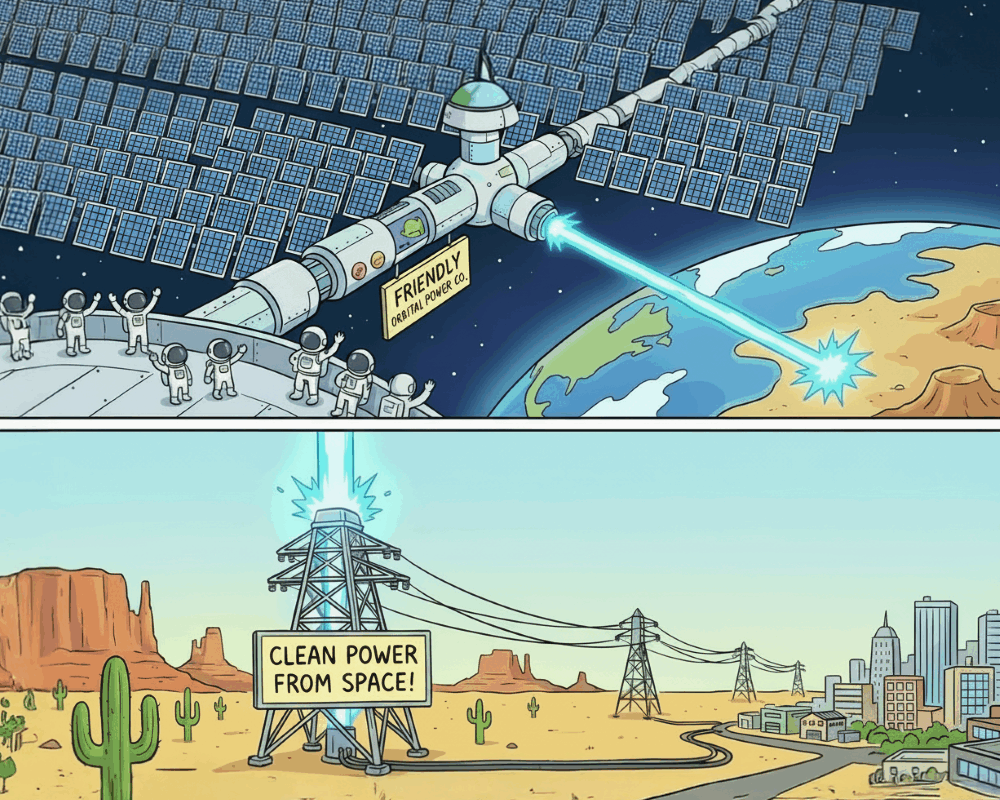
I have stopped asking questions at this point. I’ve gone far enough down the Project Blue rabbit hole and into the weeds on this topic. But it does make Elon Musk’s proposed “space power”–the ultimate renewable energy–beamed down to earth seem even more attractive.
Sign up for a free subscription to I Saw it In Tucson.
Never miss out on discoveries around the city.
If you are a Tucsonan and would like a starter tree for $5, go here for more details.